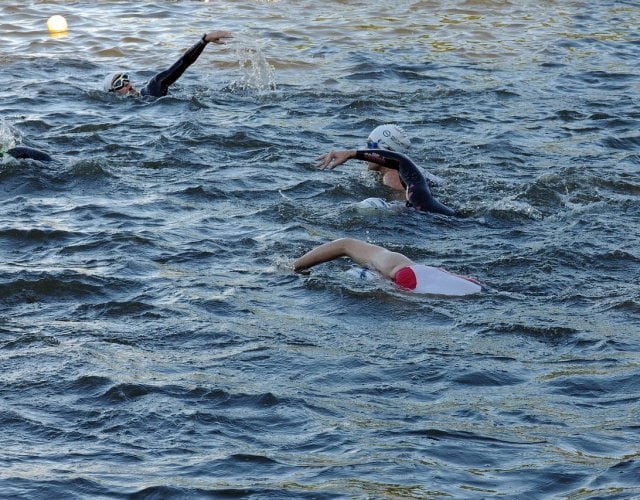
Wild swimming has seen increased popularity over recent years, with more and more people keen to try it out thanks to the potential health and well-being benefits.
In the New Forest, we’re lucky enough to have several fantastic wild swimming opportunities. The Hampshire seaside is nicely accessible with pebble and sandy beaches, making many of our best wild swimming spots coastal.
If you’re staying at one of our luxury holiday cottages in the New Forest and fancy a dip, here are some nearby spots you might want to check out.
The lovely beaches along this stretch of coastline are easy to access, rarely busy and provide decent parking (although bear in mind that you’ll need to pay in most places).
For the quietest spots, it’s often best to park up and walk a little bit until you find somewhere away from other beach-goers. The stretch between Hordle Cliff and Barton on Sea Beach tends to be the quietest area.
The swim along the coast here is relatively easy so long as it’s not windy. The seafloor dips away from the coast quite steeply when you get 5m out, so you can swim parallel to the coast if you are confident.
We often suggest Milford Beach to families because, at very low tide, you’ll get a sandbar that creates a wonderful, shallow lagoon – providing a great opportunity for some wild paddling! If you’re staying in Milford on Sea, we certainly recommend a trip down to the picturesque beach here.
If you’re staying at High Tide, you can walk to the beach in about 3 minutes – just grab everything you need for a fantastic day swimming and lounging and head out the door!

Just east of Lymington is a footpath that takes you across the Tanners Lane coastline area and toward the footpath that heads up to Lyle Court. This area is sandy, pebbly and silty – it doesn’t really have a ‘beach’ because there is a salt marsh that protects this part of the coast.
You’ll have to get past this salt marsh to swim. The best place to do this is from the end of the lane at Tanners, which is the least disruptive to the bird reserve.
The water here is usually calm because it’s opposite the Isle of Wight and the salt marshes give protection from the waves. If you can’t swim anywhere else because the weather isn’t the best, then this is your spot!
Make sure you head out at high tide because at low tide you might have to wade out through lots of mud. On windier days, you may encounter kite surfers and foil boarders. You’ll also likely see various birds including curlew, Brent geese, dunlin, plovers and more, so please be respectful of their environment.
Just along from Milford on Sea, you’ll find Hurst Castle Spit which offers some good swimming, if you find the right spot.
It should be noted that the tidal waters at the end of the Spit are very dangerous; however, on the shallow and protected side of the Spit, the lagoon waters are very gentle. For a great swim, you can take the boat taxi out to the end of the Spit and then swim from there in the tranquil lagoon.
Some people also swim from the wooden ‘crabbing’ bridge out along by the moored boats. Nobody should swim in the Keyhaven River away from the safety of the Spit unless they know what they are doing and have arranged some safety backup. It’s also not wise to swim from the quay in Keyhaven as it can get very busy with boat traffic.
Hurst Castle itself is also well worth visiting. It sits on a long pebble spit that juts out into the Solent and makes for a great pre-swim adventure. You can reach it by boat or take the 2-mile walk out.


For a bit of lighter, more casual paddling surrounded by green space, Brockenhurst River Beach, known locally as Brock Beach, is ideal. Here, shingle ‘beaches’ and idyllic grass banks frame the Lymington River, creating a picture-perfect scene.
Thanks to the shallow waters, it’s a great place for families, especially when the kids want to have a splash and cool down in the summer. There are plenty of areas to set up for a riverside picnic, too.
For more insight into the area, check out our insider’s guide to Brockenhurst.
While the routes alongside the Beaulieu River are great for a stroll, unfortunately, you cannot swim here. This is because there is a lot of traffic from boats and various watersports.
If you do want to experience the meandering river up close, head out on a kayak or paddleboard instead!

Before venturing out, we strongly recommend familiarising yourself with the most up-to-date safety advice for wild swimmers. Outdoor swimming offers an undeniable thrill, but it is not without its risks, so make sure you prioritise your safety and the safety of those around you.
// Thoroughly research the area, noting where you can safely enter and exit the water.
To find out more about the outdoor swimming prospects in the area, we spoke to Sian Toms, a local mum of 3, who quickly became addicted to wild swimming in December 2020, after needing a lockdown boost:
“Needing a challenge, I joined the local ‘Mums on the Splash’ group. A friend and I really got into it, and the freeing feeling of wild swimming – so we started training for the West Wight Charity swim.
Wild swimming gives me a feeling of euphoria. I’m addicted. It makes me feel invincible. I’m not a good swimmer, I never had the lessons my kids did. I swim with a local group and just love it.”
Sian took to the waters to raise money for the RNLI, completing a 1.3m swim from Hurst Point to Colwell Bay on the Isle of Wight. Crossing the Solent was a huge feat for Sian, finishing in the fantastic time of 75 mins and raising a stack of money in the process!

If in doubt, get in touch with a professional – someone like Angus McChesney who lives locally, spends a lot of time in the water and runs the Iconic Swims blog.
Here, he gives us the low-down on the local safety situation:
“The tricky thing about this area is that there are no lifeguards on our coast. You do have to be careful about where you go. The whole coast here has a sideways current, it’s not dangerous, but it will pull you along and can be unnerving.
If you want somewhere for an easy swim, try Hordle Cliff beach when the water is warm and the sea calm. The seafloor shelves off quite quickly and there is a natural gully that runs parallel to the coast line, between the sandbank (seen at low tide) and the coast. You need to make sure you get the tides right. It’s best to swim at about an hour before low tide. If you go at low tide you’ll be hitting your hands on the sand.
I like to get dropped off at Barton on Sea and swim back to Hordle Cliff. The tide will push you along and you can bob along and watch the beach huts. It’s about 2 miles. Lovely!”